
A type is a name, not a discount from real C
Mirror-C's type checker runs entirely inside the block editor — the machine underneath has no static semantics of its own, so a program that builds is a program the machine is guaranteed to run without a type error. What that checker enforces, and how far the fragment's type universe reaches, is this chapter.
The type universe
| Type | Notes |
|---|---|
int, char, bool |
The three scalars. char is a quarter the width of int;
see below. |
void |
A function's return type only. void x; is not a form the grammar
admits at all. |
int*, char*, bool* |
One level of indirection over each scalar. |
int**, char**, bool** |
Two levels — the ceiling. int** has existed the longest, for
main's own char** argv-shaped allocation chain; the other
two completed the set later so all three scalars reach the same depth. |
T a[n] |
One extent, fixed at declaration and never re-read from the store. |
T m[n][m] |
Two extents. Drawn as n folded rows of m cells rather than one wide strip, so filling it in nested loops shows row-major order happening instead of being told about it. |
struct S, union U, enum E |
Named types. See Structs, unions, enums. |
Two is the ceiling, for both constructors, by one decision. T a[n][m][k] and
T*** are both refused by name — in the block editor, in the type checker, and
in the text importer. Nothing about the machine underneath breaks at three levels or three
extents; the bound is pedagogical. A three-dimensional array or a triple pointer has no honest
two-dimensional picture to draw, and the picture is the thing this tool claims is faithful.
Structs, unions, enums
A struct, union or enum is referred to everywhere by
name only. The field or member list is not inlined into the type — it lives in a
definitions table on the program, looked up the same way a function call resolves a function
name. That indirection is what makes a self-referential shape like a linked list's
struct Node { struct Node *next; } expressible at all: inlining the field list would
never terminate.
- struct. Drawn as a container of cells, one per field, exactly the way an array's
elements are drawn.
p->next = qis not a metaphor for reassigning a pointer — it visibly moves the arrow from wherever it pointed toq's target. - union. One footprint, several views. The members are drawn stacked, and the
container is as wide as its widest member — a
charview visibly covers only one of the four bytes anintview covers in the same union. Writing one member makes every other member's value indeterminate; reading a member you did not last write reachesIndeterminateRead, the identical stuck reason an uninitialised scalar reaches (see Semantics). - enum. A named set of integer constants, usable anywhere an
intis expected.
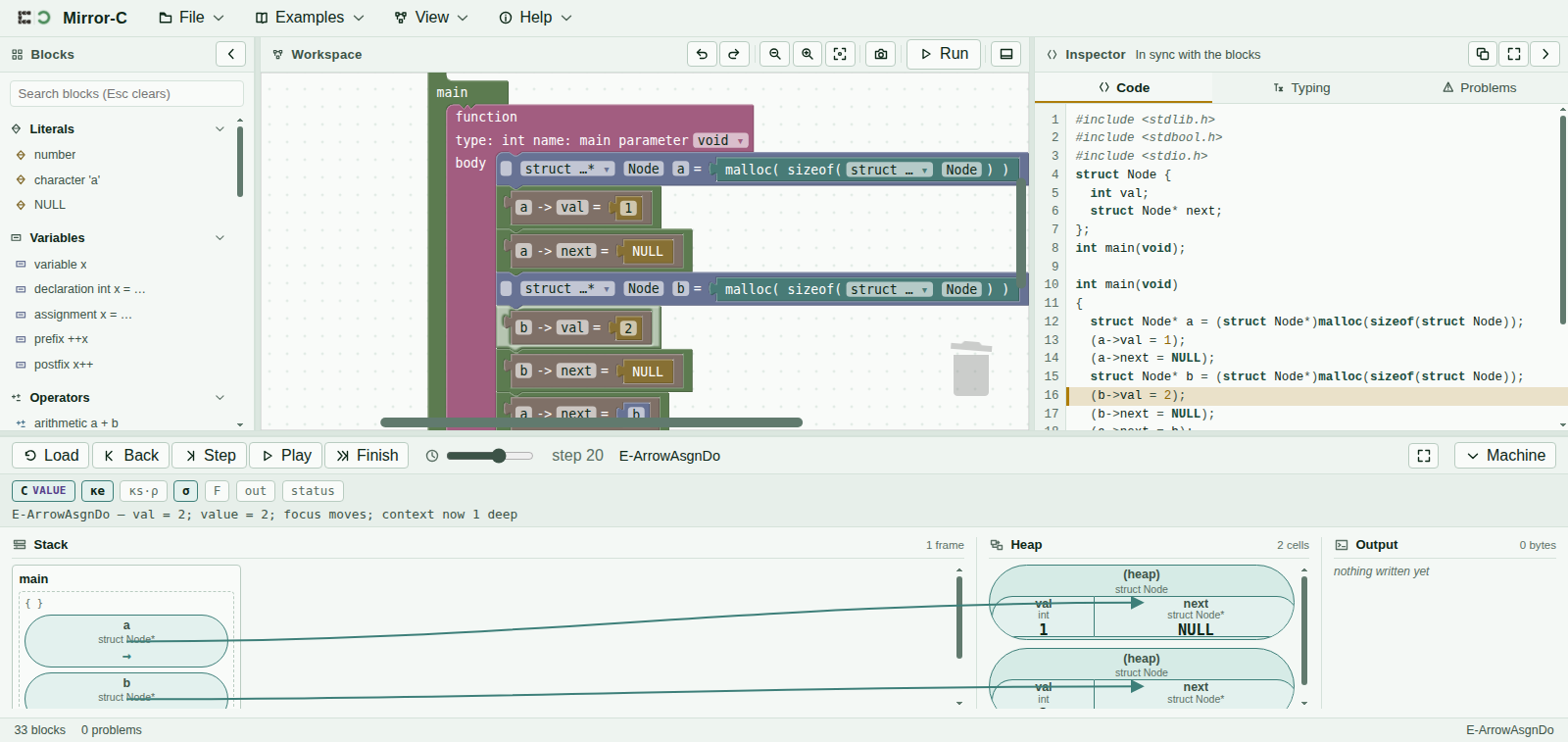
struct Node cells on the heap, a and
b pointing at them from main's frame — a container of cells,
drawn exactly the way an array's elements are.sizeof, and const
A cell's on-screen width is sizeof of its type, computed once from the type itself
and read by nothing semantic — it is geometry, not behaviour. That distinction is not
incidental: an earlier version of the checker keyed a write's truncation rule off a cell's
width rather than its type, which quietly admitted bool b; b = 44;, because
sizeof(bool) and sizeof(char) are both one byte even though the two
types convert differently. The quarter-width rule for char is still exactly a
requirement; it is just derived from the type on demand rather than stored as a fact of its own
that a rule could accidentally consult instead of the type.
const is a qualifier the machine carries and never reads. All of its force is
at the surface: the editor refuses to build any write to a const lvalue, so no
program the block editor accepts ever executes one, and the machine underneath needs no rule for
it at all. A by-value struct or union cannot be marked
const in this fragment — there is no initialiser form for one, so an
uninitialisable const object would be inexpressible either way — but a pointer to one can,
and const struct S *p is exactly where the qualifier's propagation matters: every
field reached back through p inherits the same restriction.
The Typing tab
The Inspector's Typing tab renders the same well-formedness judgement that gates ◉ Load, as a genuine derivation: pick a function, and each statement's premises expand into a classic premises-over-a-bar proof tree with the rule name at the bar's right end. Every judgement in the tree is a button — clicking one selects and centres the block it is about — and the printer icon in the tab renders the selected function's whole derivation as a one-page document.
The context threaded through the tree is not one fixed Γ. It is a sequence of
incrementally-named contexts — Γ₀ ⊢ s ⊣ Γ₁,
Γ₁ ⊢ s′ ⊣ Γ₂, and so on — because a C
function's context genuinely grows with every declaration and shrinks again at every scope exit.
A block's closing row visibly reverts to the same context name it opened with, which is the
derivation's own way of showing a scope's variables have gone out of it.
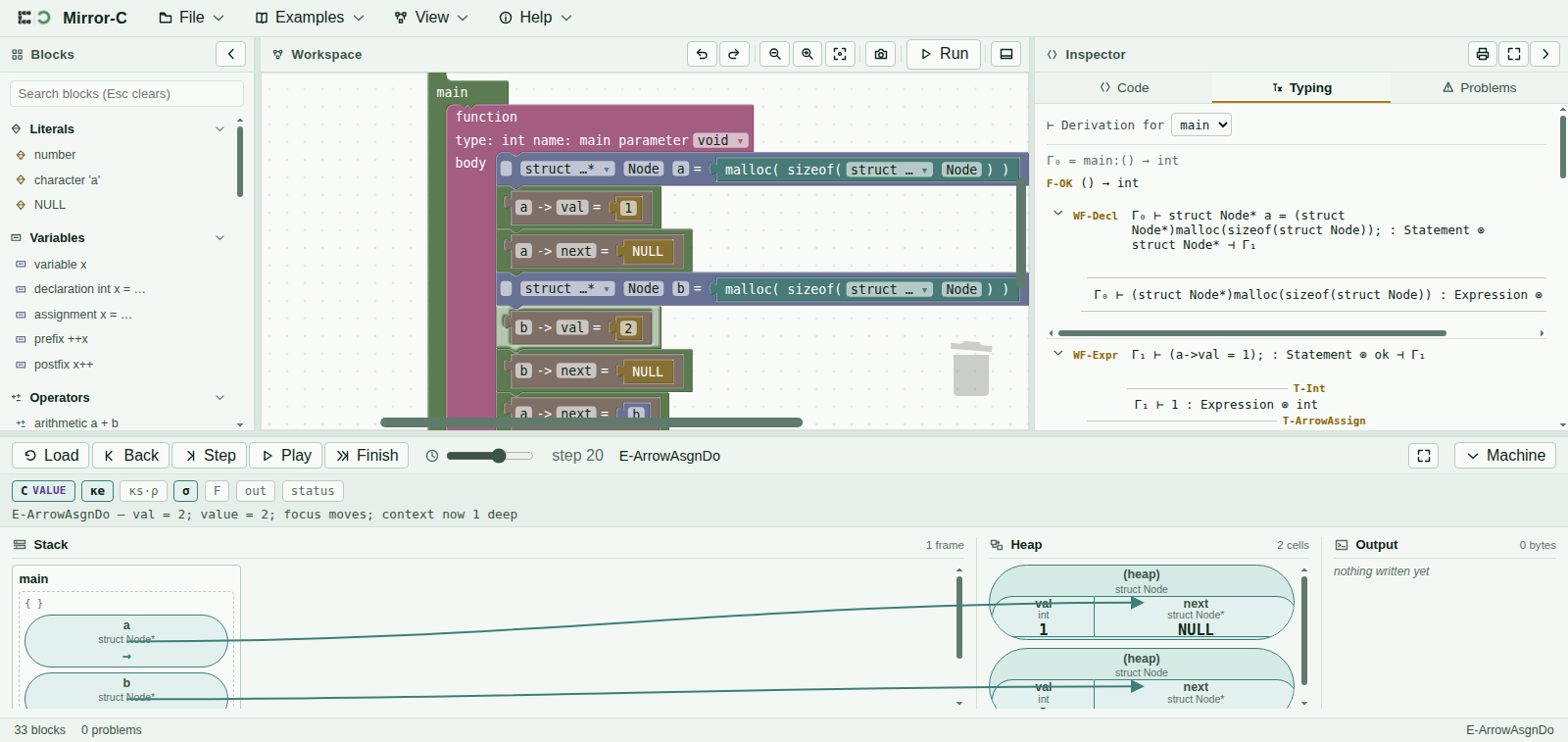
main, expanded. Each row names the rule
that justifies it, and clicking one selects the block it is about.The Problems tab
The same checker's diagnostics surface as a clickable list in the Problems tab, with a matching warning icon on the offending block and a running count in the status bar. One checker, three places the same list shows up — nothing here re-derives its own answer.
A program the block editor refuses to build is ill-typed — a Problems-tab entry,
the same thing gcc would reject before running anything. A program that builds
cleanly and then runs into undefined behaviour is stuck — a named
Reason the machine reports mid-execution. These are
different channels on purpose: a constraint a real compiler would reject at translation time
must never show up as a stuck reason, or the machine's claim that every stuck state has a
name would be describing states that were never reachable to begin with.